Recommendations for 2026

Nir Zicherman
December 23, 2025
It’s been a minute since my last installment of Z-Axis because: Wow have I forgotten what startup life is like 🤯. Two weeks ago, however, I did announce that my company Oboe raised its Series A and launched a bunch of exciting features. Give it a shot (at our new domain oboe.com).
On the eves of 2024 and 2025, I shared recommendations of the things I enjoyed most and wanted to pass along to you all. This year, I can’t say I consumed much of anything other than many, many books (while the list of movies and shows to catch up on remains quite long…). So this year’s list is made up of the ten books (by the eight distinct authors) I enjoyed most. If you also have any suggestions for next year, please reach out and let me know!
Fiction
I Who Have Never Known Men by Jacqueline Harpman - I chanced upon this book and finished it in only a couple of days, only to find out it’s become a #BookTok sensation among teenagers. Why now? And how do these trends begin? The book is an introspective dystopian novel originally published in 1995, and it’s one of those novels (like Piranesi or The Sundial) that made me feel like it was written for me, made up entirely of the things that make me love books. Harpman passed away over a decade ago and, unfortunately, didn’t live long enough to see her masterpiece finally break through.
Tyll and The Director by Daniel Kehlmann - It’s always exciting to discover a new author whose work you love. I read four books by the German author this year, including his newest, The Director, which was named one of The New York Times’s 10 best books of the year. His style is odd and postmodern and unpredictable, and his language beautiful (so hats off to his translators for finding a way to bridge that beauty across the language chasm to English). His earlier novel, Tyll, is so funny and strange, it now easily ranks among my all-time favorites.

Prankster Till Eulenspiegel, about whom Tyll was written
What Kind of Paradise by Janelle Brown - An unputdownable book that, at first glance, appears to be quite straightforward only to become a thought-provoking reflection on the good and bad that comes with the advancement of technology. I don’t know if Brown started writing the novel with AI in mind, but its release (this past summer) couldn’t have been better timed.
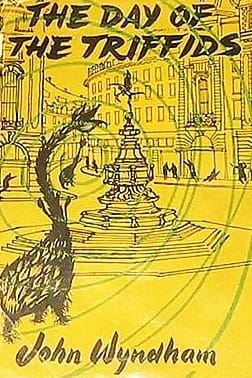
The Day of the Triffids and The Midwich Cuckoos by John Wyndham - I easily could have continued overlooking Wyndham, a British science fiction writer who published a small handful of novels in the 50s and 60s. And even upon finding him, my first reaction was: “Seriously? A book about evil plants? Another book about mind-controlling alien babies?” But boy was I wrong to doubt him. Wyndham is a fantastic writer, and I devoured both books in only a few days. I find there are two great kinds of science fiction novelists: those who cause you to think about the intellectual implications of the stories (Ted Chiang, Stanislaw Lem), and those who cause you to think about the ethical, moral, human implications (Kurt Vonnegut, Margaret Atwood, Ursula K. Le Guin). Wyndham is very much in the second category.
Non-Fiction
Fluke by Brian Klaas - The first of three books I read this year that made me aware of the importance of every passing moment. Klaas analyzes the shocking impact that the tiniest events have on the course of our lives and on history. The book’s subtitle is “Chance, Chaos, and Why Everything We Do Matters.” It’s both a suffocating and liberating point of view, and has stuck with me in a way few books have.
Four Thousand Weeks by Oliver Burkeman - Here’s a bummer: the average human life span is four thousand weeks. That is not a lot. But, as with Fluke (above), the best non-fiction books make you appreciate the significance and fragility of each moment. I think everyone should read this book at least once. It’s that impactful.
A quick aside: Four Thousand Weeks contained a quote that, while not written by Burkeman, stood out as my favorite part of the book. This one comes from Tom Stoppard’s The Coast of Utopia:
Because children grow up, we think a child's purpose is to grow up. But a child's purpose is to be a child. Nature doesn't disdain what lives only for a day. It pours the whole of itself into the each moment.
Nuclear War: A Scenario by Annie Jacobsen - I have read my fair share of spooky stories. But no book has ever terrified me more than Nuclear War. It’s a kind of half-non-fiction. The premise is simple: from the instant a nuclear warhead is launched, what exactly happens next? The book is a second-by-second, minute-by-minute exploration of every single rippling event that would follow, and the inevitable, catastrophic end it leads to. Like the two preceding recommendations, this is another book that makes you appreciate every moment, but in a radically different way.
Bossypants by Tina Fey - I’ll end on a light note. It took me nearly a decade and a half to get around to Fey’s memoir about her life in comedy. Few books have ever made me laugh out loud this much (and, given that I listened to her own narration of the audiobook on the morning train, I certainly got some strange looks from other commuters).
. . .
As always, thank you all for reading. I wish you a very happy holiday season and a happy new year. And I look forward to seeing what 2026 will bring!
— Nir